
Potty Train a Puppy Fast: 7 Easy Steps That Actually Work
Quick answer: To potty train a puppy, take them outside on a fixed schedule (first thing in the morning, after every meal, nap and play session, and right before bed), use the same spot every time, and reward them with a treat and praise the second they finish. Most puppies learn the basics in 2 to 4 weeks with consistency, but full reliability often takes 4 to 6 months.
House training is the first big project for every new dog owner, and it is also the one that causes the most stress. The good news: it is not about having a “smart” or “stubborn” dog. It is about routine, timing and patience. In this step-by-step guide, you will learn exactly how to potty train a puppy, how long it usually takes, which mistakes slow progress, and what to do when accidents happen.
Key Takeaways
- Puppies can hold their bladder for roughly one hour per month of age, up to about 8 hours for adult dogs.
- A consistent schedule is the single most important part of learning how to potty train a puppy.
- Reward within 2 seconds of your puppy finishing outside, so they connect the treat with the action.
- Never punish accidents. Clean them with an enzyme cleaner and supervise more closely.
- Crate training, when done kindly, speeds up house training for most puppies.
When Should You Start to Potty Train a Puppy?
You can start the day your puppy comes home, usually at 8 to 12 weeks old. Very young puppies have small bladders and limited control, so expect accidents at first. Starting early still helps, because your puppy learns that outside is the bathroom before indoor habits form.
Before puppies are fully vaccinated, ask your veterinarian which outdoor areas are safe. A private yard or a quiet area that other dogs do not use is usually the best choice. The American Kennel Club also recommends picking one potty spot and returning to it every time.
What You Need Before You Start
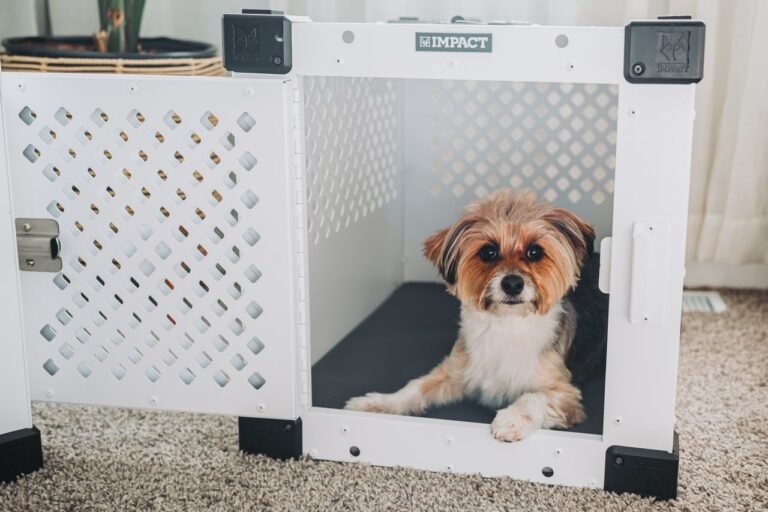
- A crate big enough for your puppy to stand, turn and lie down, but not so big that one corner becomes a toilet.
- Small, soft training treats. See our list of healthy dog treats for training.
- A leash and collar or harness so you can guide your puppy to the same spot.
- Enzyme-based cleaner to remove odors completely after accidents.
- A simple log (paper or phone) to track meals, potty breaks and accidents.
How to Potty Train a Puppy in 7 Steps
Step 1: Set a fixed feeding schedule
What goes in on a schedule comes out on a schedule. Feed your puppy at the same times every day, usually three meals for young puppies, and pick up the bowl after 15 to 20 minutes. Avoid free-feeding during house training, because it makes bathroom timing unpredictable.
Step 2: Take your puppy out at the right times
Young puppies need to go out very often. Take them out:
- Right after waking up in the morning and after every nap
- Within 5 to 15 minutes after eating or drinking
- During and after play sessions
- After getting out of the crate
- Right before bedtime
- About every 1 to 2 hours during the day for puppies under 4 months
Step 3: Use the same spot and a cue word
Walk your puppy on a leash to the same patch of grass every time. The smell helps them remember why they are there. When they start to go, calmly say a short cue such as “go potty.” Over time, the cue word helps your puppy go on command, which is very useful when traveling or in bad weather.
Step 4: Reward immediately
The moment your puppy finishes, give a treat and happy praise. Timing matters: if you wait until you are back inside, your puppy will think the reward is for coming in, not for going outside. This single habit is the fastest way to potty train a puppy.
Step 5: Supervise inside the house
Most accidents happen when no one is watching. Keep your puppy in the same room as you, use baby gates, or attach a light leash to your belt. Watch for signs such as sniffing the floor, circling, whining, or suddenly walking away from play. When you see them, go outside right away.
Step 6: Use the crate for naps and short breaks
Dogs naturally avoid soiling their sleeping area. A crate used for naps and short periods teaches your puppy to hold it. Never use the crate as punishment, and do not leave a young puppy inside longer than they can physically hold their bladder.
Step 7: Handle accidents calmly
If you catch your puppy in the act, calmly interrupt them with a short sound, pick them up or lead them outside, and reward them if they finish there. If you find an accident later, simply clean it. Punishing after the fact only teaches your puppy to hide when they need to go.
Sample Puppy Potty Training Schedule
Here is a simple daily schedule for a 10 to 12-week-old puppy. Adjust the times to fit your day, but keep them as consistent as possible.
| Time | Activity |
|---|---|
| 6:30 AM | Wake up, go straight outside |
| 7:00 AM | Breakfast, then outside 10 minutes later |
| 7:30 – 9:00 AM | Play and short training, potty break after play |
| 9:00 AM | Nap in crate, potty break on waking |
| 12:00 PM | Lunch, then outside |
| Every 1–2 hours | Potty breaks during the afternoon |
| 5:00 PM | Dinner, then outside |
| 7:00 PM | Remove water bowl (unless it is hot or your vet advises otherwise) |
| 10:00 PM | Last potty break, then bed |
| Overnight | One or two quiet breaks for puppies under 4 months |
How Long Can a Puppy Hold Their Bladder?
A common rule of thumb is one hour per month of age, plus one. This is only a guide; small breeds often need more frequent breaks.
| Puppy age | Approximate holding time |
|---|---|
| 8–10 weeks | 1–2 hours |
| 3 months | 2–3 hours |
| 4 months | 3–4 hours |
| 5 months | 4–5 hours |
| 6 months and older | Up to 6 hours, gradually longer as an adult |
How to Potty Train a Puppy at Night
Night training follows the same rules, with a few extra tips:
- Keep the crate in or near your bedroom so you hear your puppy wake up.
- Make night breaks boring: no play, no long talking, lights low.
- Go straight to the potty spot, wait a few minutes, reward, and go back to bed.
- Set an alarm for one break in the middle of the night for very young puppies, and slowly push it later as they grow.
Most puppies can sleep through the night by around 4 to 5 months of age.
How to Potty Train a Puppy in an Apartment
Living in an apartment adds stairs, elevators and longer walks to the grass. These tips help:
- Carry very young puppies to the door so they do not have an accident on the way.
- Keep shoes, leash and treats ready by the door for fast exits.
- Consider a balcony grass patch or potty pads as a temporary backup, then move away from them gradually.
- Choose a quiet potty spot close to the building entrance.
If you are still choosing a breed for a small home, read our guide to the best small dog breeds for apartments.
Puppy Pads: Helpful or Harmful?
Pads can be useful for very young puppies, people who work long hours, or high-rise living. The downside is that they teach your puppy that going indoors is acceptable. If you use pads, keep them in one place, move them closer to the door over time, and then outside. Many trainers recommend skipping pads if you can take your puppy out often.
7 Common Mistakes When You Potty Train a Puppy
- Giving too much freedom too soon. Expand access to the house one room at a time.
- Inconsistent timing. Irregular meals and breaks lead to irregular results.
- Late rewards. Reward outside, right when your puppy finishes.
- Punishing accidents. It creates fear and makes puppies hide.
- Using regular cleaners. Ammonia-based products can smell like urine and attract repeat accidents.
- Coming inside too fast. Give your puppy a few calm minutes; some puppies need time to settle.
- Stopping too early. A few good days does not mean training is finished. Keep the routine for weeks.
Why Is My Puppy Still Having Accidents?
Setbacks are normal, especially around 4 to 6 months when puppies become more confident and distracted. If accidents continue, check these causes:
- Too long between breaks. Go back to a tighter schedule for a week.
- Excitement or submissive urination. Keep greetings calm and low-key.
- Marking, especially in unneutered males. Talk to your vet about options.
- Medical problems such as urinary tract infections, parasites or digestive upset.
See your veterinarian if your puppy suddenly has many more accidents, drinks much more water than usual, strains to urinate, or has blood in their urine. A vet visit can quickly rule out a health problem. Unexpected vet visits are one reason many owners consider pet insurance; learn more in Is Pet Insurance Worth It?
Potty Training and Socialization Go Together
Going outside several times a day also exposes your puppy to new sounds, people and surfaces. Use these short trips as gentle socialization moments. Our guide on how to socialize a puppy the right way explains how to do this safely, and our complete puppy care guide covers feeding, vet visits and daily routines.
How Long Does It Take to Potty Train a Puppy?
Most puppies understand the basic idea within 2 to 4 weeks of consistent training. Being fully reliable, with almost no accidents, often takes 4 to 6 months, and some puppies need up to a year. Small breeds, puppies from pet stores or shelters, and puppies with irregular early routines can take longer. Progress is rarely a straight line, so measure it over weeks, not days.
Week-by-Week Plan to Potty Train a Puppy
Breaking the process into weeks makes it easier to stay consistent and see progress. Use this plan as a simple roadmap.
Week 1: Build the routine
Your only goal this week is to potty train a puppy around a predictable schedule. Go out every 1 to 2 hours, after meals, naps and play. Reward every success outside and supervise every minute indoors. Expect accidents; they are part of learning.
Week 2: Add the cue word and longer gaps
Keep the same schedule but add your cue word consistently. If your puppy has had several accident-free days, stretch the time between daytime breaks by 15 to 30 minutes.
Week 3: Expand freedom slowly
Give your puppy access to one extra room while you watch. If accidents return, go back a step. Many owners who try to potty train a puppy too quickly skip this stage, and that is where most setbacks begin.
Week 4 and beyond: Make it reliable
Keep rewarding outdoor success, even when it starts to feel automatic. Slowly reduce treats to occasional rewards while keeping praise. Continue the routine for several months; the habits you build now will last for your dog’s whole life.
Keep in mind that every dog is different. If you potty train a puppy from a small breed, plan for more frequent breaks, because tiny bladders fill faster. If you potty train a puppy from a large breed, they may hold it longer but still need the same consistency. The method stays the same; only the timing changes.
Positive Reinforcement: Why It Works
Modern trainers and veterinary behavior experts recommend reward-based training because it builds trust and clear communication. When you potty train a puppy with treats and praise, your puppy learns that going outside earns something good. When owners use punishment, puppies often learn to fear the owner rather than to understand where to go. Reward-based methods are kinder, and they are also faster for most dogs.
Quick Checklist to Potty Train a Puppy
Print this list or save it on your phone. It sums up everything you need to potty train a puppy successfully:
- Fixed meal times and no free-feeding
- Breaks after sleep, meals, play and crate time
- One potty spot and one cue word
- A treat and praise within 2 seconds of success
- Full supervision indoors, or a crate or playpen when you cannot watch
- Enzyme cleaner for every accident, and no punishment
If you follow this checklist every day, you will potty train a puppy much faster than with random breaks. Owners who potty train a puppy with a written plan usually see fewer accidents in the first month, simply because nothing is left to memory. And if you ever feel stuck, go back to the basics: more breaks, more supervision and quicker rewards. That is truly the simplest way to potty train a puppy, whatever the breed or age.
Signs Your Puppy Needs to Go
Learning your puppy’s body language makes it much easier to potty train a puppy without constant accidents. Watch for these signals:
| Sign | What it usually means | What to do |
|---|---|---|
| Sniffing the floor in circles | Looking for a spot | Go outside immediately |
| Whining or scratching at the door | Asking to go out | Respond fast and reward at the potty spot |
| Suddenly leaving play | Bladder or bowel pressure | Interrupt play and take a break outside |
| Restlessness after eating | Bowel movement coming soon | Head out within 5 to 15 minutes |
| Squatting or lifting a leg | Going right now | Calmly interrupt and move outside |
Tips for Busy Owners and Working From Home
- Book a midday helper. A neighbor, family member or dog walker can cover breaks while you are at work.
- Use a playpen. A pen with a bed, water and a pad in one corner is safer than free access to the house when you cannot supervise.
- Set phone reminders. If you work from home, it is easy to lose track of time. Alarms every 60 to 90 minutes help.
- Keep everyone on the same plan. Write the schedule and cue word on the fridge so every family member follows the same rules.
Potty Training an Older Puppy or Rescue Dog
The same method works for older puppies and adult rescue dogs. They often have better bladder control, so progress can be faster, but they may also have learned habits like going on carpets or pads. Treat them like a new puppy for the first few weeks: frequent breaks, close supervision, quick rewards and patience. Stress from a new home can cause accidents in the first days, and these usually fade as your dog settles in.

Frequently Asked Questions
What is the fastest way to potty train a puppy?
The fastest way is a strict routine: frequent scheduled breaks, the same potty spot, an instant reward after success, close supervision indoors and calm crate use. Consistency from everyone in the home matters more than any special product.
Can you potty train a puppy in 7 days?
You can make huge progress in 7 days and teach your puppy the routine, but most puppies are not fully reliable after one week. Expect a few weeks for solid habits and several months for complete control.
Should I wake my puppy up at night to pee?
For puppies under about 12 weeks, one planned night break is often helpful. As your puppy grows, let them wake you instead, and gradually reduce night breaks.
Is it harder to potty train a puppy in winter?
Cold, rain and snow make puppies want to rush back inside. Clear a small area, use a short coat for tiny breeds, and stay out until they finish. The routine stays the same.
Do boy or girl puppies potty train faster?
There is no strong evidence that one sex learns faster. Breed size, routine and consistency have a much bigger effect than sex.
What should I do if my puppy pees in the crate?
The crate may be too large, your puppy may be left in too long, or there may be a health issue. Make the crate smaller with a divider, shorten crate time, and talk to your vet if it keeps happening.
Final Thoughts
Learning how to potty train a puppy is mostly about building a routine your puppy can predict. Take them out often, go to the same spot, reward right away, supervise indoors and stay calm when accidents happen. With patience and consistency, your puppy will learn where to go, and both of you will enjoy a cleaner, calmer home.
Disclaimer: This article is for general information and does not replace advice from your veterinarian or a certified dog trainer. If your puppy shows signs of illness or ongoing accidents, contact your vet.
One Comment
Comments are closed.